i
Tonight, April 6, 2026, four astronauts crossed behind the moon and lost all communication with the Earth. About forty minutes later, they reestablished contact, and the world was made anew.
The night Artemis II launched, I left work that evening to a full moon right outside. I laughed, the sound almost a bark, out of some strange reflex. The night after, I couldn't sleep. The moon shone too bright outside my window. All this week I have not been able to look up at the night sky without thinking of the crew up there. For the better part of their ten day mission, humanity's reach has temporarily grown by two orders of magnitude. How small we must all look from up there. How beautifully, wonderfully human it is that we use up our limited uplink budgets and payload capacity to do things like stream Chappell Roan one hundred seventy thousand miles into deep space. As of writing, downlink of post-flyby crew video will begin in four hours. With it will likely come the photographs taken by the Artemis II crew from the dark side of the moon. I look most forward to their images of earthset and earthrise. I think that to me, they'll be two of the defining images of this century.
Artemis has affected me more deeply than I imagined it would. It's hard to put into words without falling into cliches, or start parroting certain figures. So instead I'll tell another, very short story.
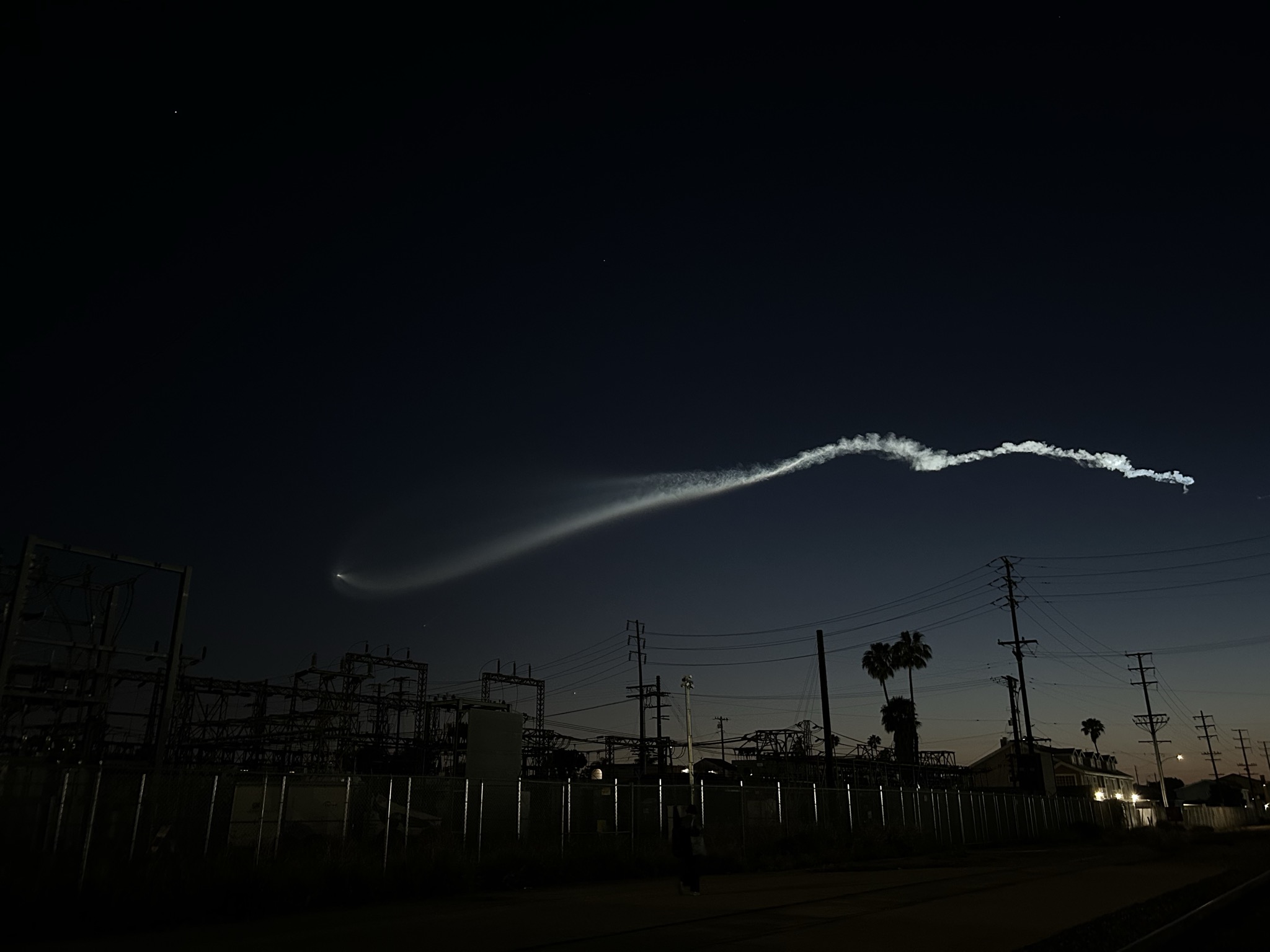
Tonight, I left work and I saw a Falcon.
They're routine, around here. My camera roll is littered with their jellyfish trails, the result of sunlight reflecting off their plumes. You'll see flashes in their wake as light glints across particularly dense parts. They're stunning.
I hope this decade brings with it immeasurably more, immeasurably beautiful spaceborne routines. And I hope that in the decade after that, as we look beyond Earth's orbit, that we will increase humanity's reach by two more orders of magnitude. This time for good.
ii
Tomorrow, April 7, 2026, people will stop being born. On the same day, people will stop dying, and people will stop aging.
17776 is a story about sentient space probes. It is about what it means to be human when all relevant biomarkers that'd normally bookend a human life have become irrelevant. It's about the American undying love for football. It's about a never fading always burning light in the San Francisco Bay Area. It's about a lot of things.
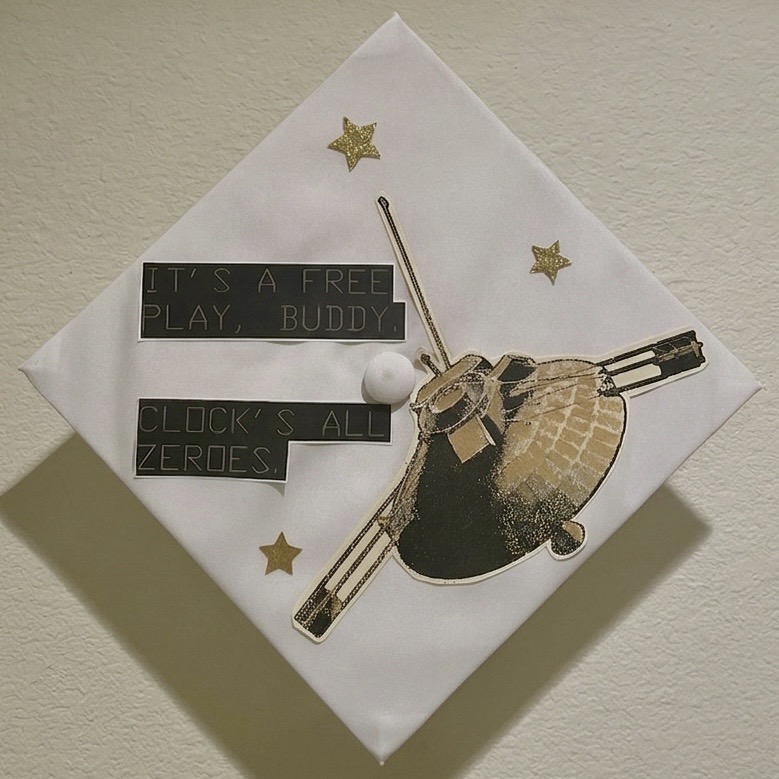
It was deeply comforting when I was in high school. My graduation cap featured one of its characters, Pioneer 10, and a truncated quote from its final page, which ends with 'It's after the end of the world.' Something about the idea of a future where humanity was given the gift and freedom to relax, to release the tension in our spines and find indefinite peace and endless time for recreation, appealed to me deeply. Back then, I fully believed that I would be absorbed by the background radiation of Silicon Valley. That I'd find a nice, comfortable, boring software engineering job and hang onto it as long as I could. For various reasons, I didn't dare dream of anything but financial security. It felt like that was already insurmountably more than I could ask for.
I did not think then that I would be working full time on space exploration and communication systems, perhaps ironically so given 17776's protagonists. Somewhat anti-thematically to the graduation cap, my high school yearbook quote was 'Nothing ventured, nothing gained.' I must have taken it to heart.
What goes around comes around, in a very roundabout kind of way. My father used to work for a company called T Zero, the same name as the first instant of a mission. You will not find much on it online other than a valuation estimate or two. Its name has no relation to mission timing, or aerospace at all. My mother grew up in Kazakhstan, where one thousand miles away from her, the Soviets kept the heart of their space program, beating with every new launch (and closer by, they conducted underground nuclear testing, and closest of all, they refined oil and nuclear waste and heavy metal ore). Even the Bay Area software job market has an indirect connection; much of the initial funding that started to flow into the valley in the first half of the twentieth century came from government contracts developing radio and avionics systems. (The reason why Apple cofounder Steve Wozniak grew up and attended the same community college as I did in Cupertino was because his father had initially moved there to work for Lockheed. Among other things, they built the launch escape system for Apollo, and now, they build Artemis's Orion crew capsule.)
"The clock's all zeroes." T+0. The end, the beginning. What difference does it make, really?
Today is the first day of the rest of our lives. That means your life, too.
What are we going to do with it?